
Here’s a helpful guide for getting the very best from your Baby Brezza Bottle Washer Pro. These quick tips and tricks will help keep your machine running smoothly and ensure your baby’s bottles are cleaned safely and effectively every time.
How do I change the HEPA filter?
Here’s how to change the HEPA filter in your Washer Pro, this is a simple maintenance step that helps keep the drying air clean and your machine running at its best.
- Turn Off & Lay on Its Side
- Make sure the Bottle Washer Pro is turned off and unplugged, a small amount of water may spill out of the sump but don’t worry, this is normal.
- Open the Filter Cover
- Remove the Old Filter
- This can be easily removed by pulling the tab. Dispose of the filter accordingly
- Insert the New Filter
- Replace the Filter Cover
- Make sure this is correct inserted into place to avoid the cover or filter itself falling out during use
You’ll need to change the filter every 3 months when using the machine once a day, more or less frequent usage may require the filter to be changed sooner. Replacement HEPA filters can be purchased from the Baby Brezza UK website here.
How is it different to a standard dishwasher?
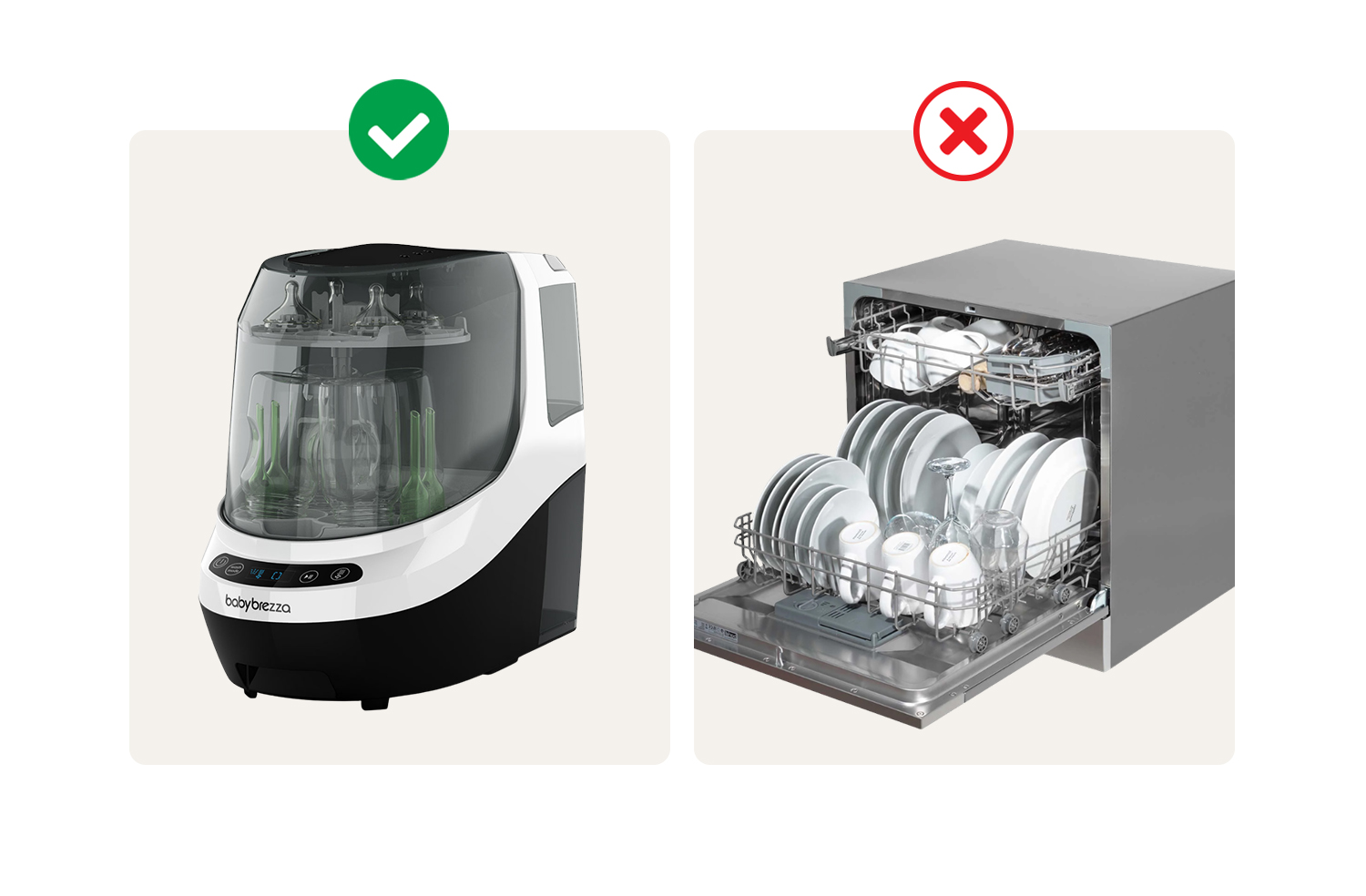
Washing bottles, pump parts and accessories in the Baby Brezza Bottle Washer Pro is very different (and better) than using a dishwasher. Here’s why:
- Cleans more effectively with 20 direct spray jets vs two spray arms – the Bottle Washer Pro has 20 high-pressure direct spray jets that blast bottles, pump parts and accessories with water to wash and rinse. Most dishwashers only have 1 or 2 spray arms that rotate and don’t directly spray water on items inside. As a result, the Bottle Washer Pro ensures that even the tiny crevices are cleaned in your baby products.
- Has specific racks for optimal cleaning – the Bottle Washer’s racks are designed to accommodate baby bottles, teats and vent tubes to ensure they are thoroughly washed, rinsed, sterilised and dried
- Sterilises vs dishwashers that don’t – the Bottle Washer offers a sterilisation cycle which uses natural steam to kill 99.9% of germs. Dishwashers do not sterilise – they only sanitise which uses hot water up to 73°C, this doesn’t kill 99.9% of germs like the Bottle Washer Pro
- Takes less time – the Bottle Washer washes, sterilises and dries in 88 minutes. Most dishwashers take between 2-5 hours to wash and dry and even longer if you include sanitising. And if you’re in a rush, you can select from 6 settings, five of which take less time including Wash Only, Dry Only, Wash & Dry, Sterilize & Dry, or Sterilise Only.
- Uses 80% less water than a dishwasher - The Bottle Washer Pro uses less than 3.7L of water for a wash-sterilise cycle whereas a typical high-efficiency dishwasher uses 15L of water and a standard dishwasher uses 6 gallons of water for the same cycle.
- No mixing with food residue or heavy detergents that are common in household dishwashers –Washing your baby products in the Bottle Washer Pro keeps them separate from the rest of your household items and avoiding any food residue or strong detergent from coming into contact with your little ones bottles, accessories etc.
How do I use my MAM bottles with a base that unscrews?
When using MAM anti-colic bottles (or any bottles where the base completely unscrews) with the Bottle Washer Pro, it’s important to not fully remove the base before washing.
If the base of the bottle is removed you’ll be left with a cylinder. The Bottle Washer Pro is unable to clean the cylinder effectively, as the spray jets will miss the edges of the bottle. To make sure the bottle gets fully cleaned — including all the little nooks and crannies — keep the base attached and placed on the bottle during washing. Check out our handy guide here showing how best to arrange your bottles in the Bottle Washer Pro.
Just remember to remove the silicone vent from the base and place the vent on the top rack so it can be cleaned properly.
What are the Bottle Washer Detergent Tablets made from?
Below is a simple breakdown of what’s inside the Bottle Washer Pro Detergent Tablets and what each component does:
- 38% Citric Acid Anhydrous - Found naturally in citrus fruit such as lemons and limes and is a weak acid used as a disinfectant and a natural preservative for the tablets.
- 25% Sodium Bicarbonate - Commonly known as baking soda. It is often used in cleaning for its ability to neutralize odors.
- 17% Sodium Percarbonate - All-purpose oxidizer. It has the ability to decompose in water without having any kind of impact on the environment from the point of view of pollution. With its whitening, sanitizing and stain removing, disinfecting, antifungal and antibacterial properties, it makes an eco-friendly alternative to household detergents.
- 10% Sodium Dodecyl Sulfate - A mild detergent to break down proteins in milk residue, cleaning bottles more effectively.
- 4% Sodium Carboxymethyl Cellulose - A stabilizer for the tablets. It is a commonly used food additive which improves the shelf life, look, and texture of several foods.
- 4% PEG-6000 - A binder and anti-caking agent for the tablets
- 1% Protease - An enzyme used to break down proteins in milk residue and clean bottles more thoroughly.
- 5% Ethylenediaminetetraacetic Acid Disodium Salt - An agent that's used to reduce the reactivity of metal ions. It's also used to treat calcium overload.
- 5% Sodium Benzonate - A mild preservative used to prevent the tablets from molding. It's added to a wide variety of foods, including mayonnaise, margarine, carbonated drinks, jams and jellies, sauces, and tomato paste.